Most salespeople spend their week on the deal that’s loudest, not the one most likely to close. Pipedrive’s AI Sales Assistant watches every deal and tells you, roughly, where your time would pay off better. I’ll skip the feature tour. Here are three ways to turn it into money, starting with the cheapest.
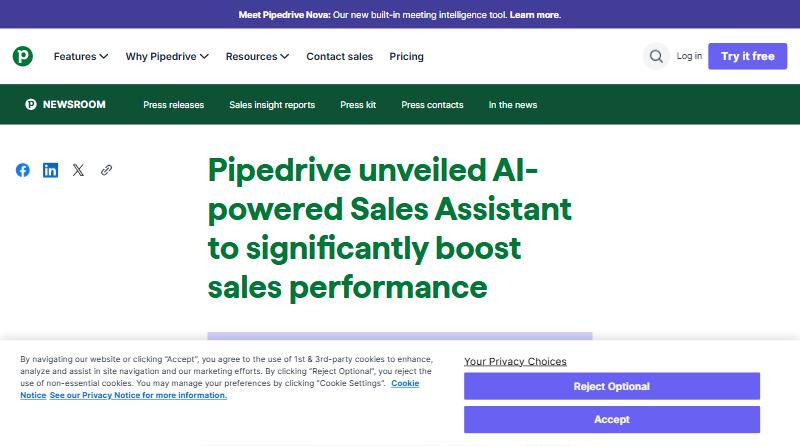
Image: Pipedrive, from the official Pipedrive newsroom
Play 1: Chase the stale quotes this week, not next quarter
The money: quotes that went out and went quiet. They’re the cheapest revenue you’ll ever win back, because the work is already done.
How I’d run it:
- Ask the reporting assistant in plain English: “Show me deals over $10k in the quote stage with no activity for more than 21 days.”
- For each one, open the deal and use the email writer to draft a follow-up that refers to something specific from the deal history, not “just checking in.”
- Read every draft before it goes. Fix anything that sounds generic. Send.
- Tag these deals and compare how many move in 30 days against the rest.
The maths, as an example: 15 stale quotes at $20k each is $300k sitting still. If specific follow-ups revive three of them and you win one, that’s $20k from an afternoon. Pipedrive’s own figure for the email writer is drafting time dropping from about 9 minutes to 44 seconds per email; treat that as their claim, but the direction is believable.
Play 2: Let the Assistant tell you which deal deserves your Friday
The money: deals with a real chance of closing that get neglected because another deal is more demanding.
How I’d run it:
- Each Monday, look at the deals the Assistant flags as a “better opportunity” or as going stale.
- Compare that list with where you actually spent last week. Where they disagree, ask yourself why, honestly.
- Move one hour this week from your noisiest deal to its top-flagged deal.
The maths, as an example: you don’t need the AI to be right every time. If shifting one hour a week to better deals adds one extra win a quarter at your average deal size, that’s the value.
Play 3: Get the Monday pipeline numbers in five minutes
The money: an hour of a manager’s time every week spent building filters and spreadsheets for the sales meeting, plus the decisions that don’t happen because the numbers came late.
How I’d run it: replace the hand-built report with three plain-English questions asked every Monday: what’s stalled, what moved stage, and what’s due to close this month that hasn’t been touched in a fortnight. Put the three answers at the top of the meeting agenda and spend the meeting on decisions instead of reading figures out loud.
How I’d actually do it
Start with Play 1. It’s money already on the table and it works this week. Play 3 is a quick win for the manager. Play 2 is the slow one, because it asks people to change habits.
What I’d ignore for now: win-probability scores on a thin history. If you’ve closed 30 deals in total, the model hasn’t got much to learn from, so use the scores as a nudge, not a forecast. The voice-and-text agent mode is still in limited beta, so don’t plan around it.
Where this fits
Pipedrive Nova feeds this Assistant with what was said on calls. The follow-up drafting works the same way as drafting CRM follow-ups with AI. If the “stale deal” list is enormous because nobody owns deals, fix ownership first; that’s CRM Pipeline Rescue.
What shipped, for reference: Pipedrive’s AI Sales Assistant includes deal recommendations (“better opportunity”, stale-deal flags), an AI email writer and summariser, plain-English reporting, and a chat panel for pipeline questions. Voice-and-text agent mode is in limited beta.
Source: Pipedrive.