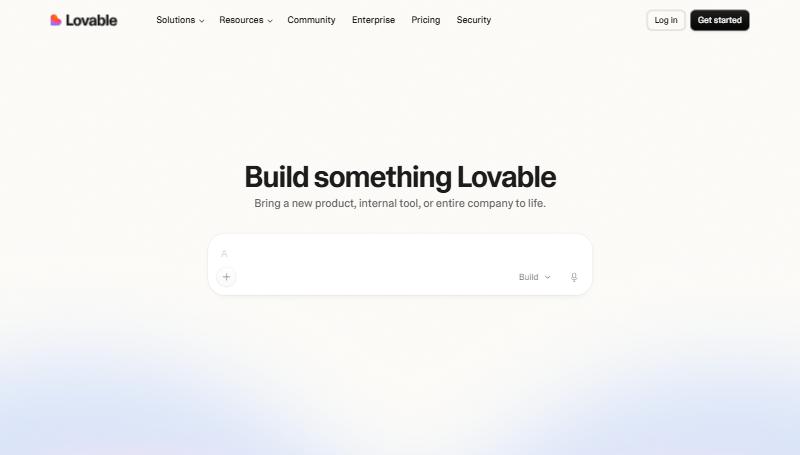
Every technical business has a tool it “should build sometime”: the quote calculator, the proper enquiry form. It never happens because it’s never worth hiring a developer for two weeks. Lovable builds working web apps from a plain-English description, so that sum changes. I’ll skip the feature list. Here are three small tools that pay.
Image: Lovable, from the official Lovable website
Play 1: A quote calculator that turns quotes in hours, not days
The money: jobs lost because your quote arrived three days after a competitor’s, when most of the pricing was a formula in someone’s head.
How I’d run it:
- Write down the pricing logic as plainly as you can: base price, options, quantities, freight zones, margin floor.
- Describe it to Lovable: “Build an internal quote calculator. Inputs: product type, quantity, options from this list, delivery postcode. Output: line items, total ex GST, and a warning if margin is under 22%.”
- Test it against your last 20 real quotes. Fix it until it matches.
- Use it for first-pass quotes; the estimator reviews anything unusual.
The maths, as an example: if quotes go out in hours instead of days and that wins one extra $20k job a month, that’s $240k a year from a tool that took a few days to build.
Play 2: An enquiry form that creates clean records
The money: enquiries that arrive as messy emails, get retyped by hand, and lose the details the estimator needed.
How I’d run it:
- Ask Lovable for a form that asks the estimator’s real questions (application, quantity, timeframe, site, drawings upload) and saves each enquiry as a structured record.
- Send each new record to the CRM, or at least to one shared table everyone can see.
Play 3: A reorder page for repeat customers
The money: consumables and spare parts customers would reorder more often if it were easier than emailing you.
How I’d run it: build a simple logged-in page showing each customer’s past orders with a “reorder” button that sends the order to your team. Keep payments out of it to start with; let your existing invoicing handle that until the tool has proven itself.
How I’d actually do it
Start with Play 1. Quote speed wins jobs, and the pricing logic is usually simpler than people think once it’s written down.
The caveat: Lovable writes the code; it doesn’t check it for you. Anything that touches customer data, payments or compliance needs the same review a developer’s work would get. Treat the output as a competent first draft. Keep the tools small, single-purpose and easy to throw away.
Where this fits
Pair Play 2 with Zapier Agents to route each enquiry automatically. If the real problem is that nobody trusts the CRM those records land in, no internal tool will fix it; that’s CRM Pipeline Rescue.
What shipped, for reference: Lovable builds full-stack web apps (React front end, Supabase back end with database, login and storage) from a chat description, lets you edit elements in place, deploys in one click, syncs to GitHub and connects to Stripe.
Source: Lovable.